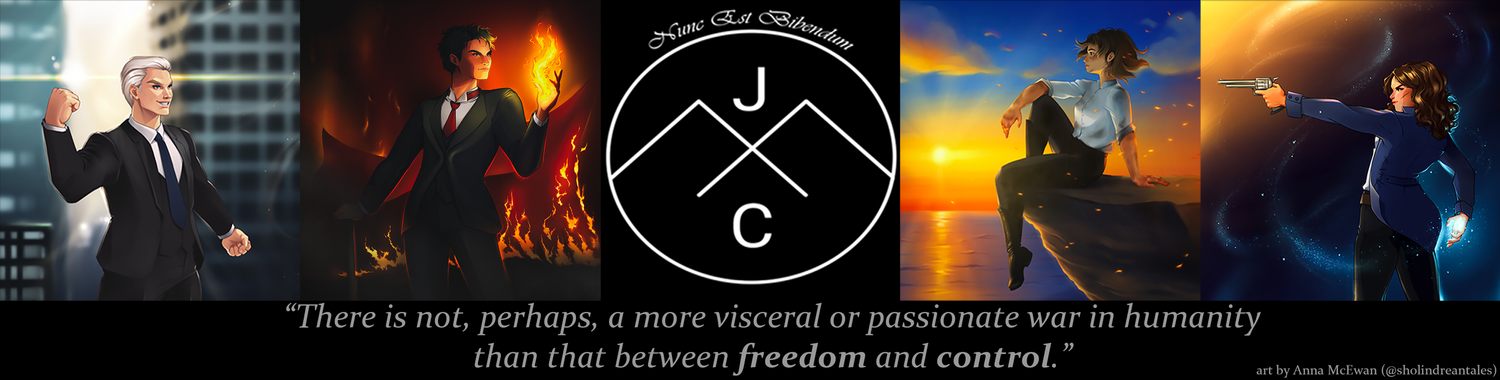
As we approach the beginning of the end of the Freedom and Control series, I can’t help but get a little nostalgic. This is a story which has survived multiple relationships and breakups, homes and moves, laptops and external storage drives. Telgora as a world has existed since the start of high school, and the version which came to life in A Place I Have Never Been has lived since my sophomore year of college. Beyond writing this series, I have written poetry, a short story which was published, a play which was performed in Boston, and a whole separate fantasy series which will be my next independent publishing project.
But it’s that next which has me a little anxious about completing Freedom and Control. For the first time in my creative life, in about a year, I will not have the template of this editing and release schedule to determine the course of my productivity. I had a year break between the third and fourth books in part because life had gotten crazy and because I had the play to worry about. But we’re still on track for the outline I crafted almost ten years ago—hopeful as foolish as I was that I could complete a first-ever fantasy novel and get it published.
Four rounds of rejections since then have informed me just how young and foolish I was.
There’s some nostalgia for the person I was when this series began, but only some. The Justin of college is not the Justin of now, and in many ways I am, he is, better for it. Going back and editing these words shows me some of that journey. It’s a time capsule to an era where it seemed more was possible. I haven’t entirely given up hope of being traditionally published, nor have I given up entirely on writing. But life, they say, does get in the way of living sometimes. One can only suffer so many of the punches before one gets wiser about picking their fights.
I think somewhere along the line, that evolution began with the character of Eilatek. If there is a part of me in my writing, and those of us who read and write understand that there are pieces of us in everything we read and write, it lives in both Eilatek and in Zhaekota. Eilatek was that optimism of a bygone age. She was older than me when I began writing Freedom and Control, and now she is far younger than me. But over the course of the series, I have watched her shift from a black-and-white revolutionary idealist bent on burning the world down and rebuilding it in her image to a pragmatic, almost wistfully romantic leader of others who wish to do the same. If the other characters are wise, they would do well to listen to her. If she’s wise, she would do well to listen to me. But it was The French Lieutenant’s Woman which taught me that our characters only really live when they disobey us.
Nowhere has that been more true than with Zhaekota, who at one point seemed to be an embodiment of something I think I feared to become. Never, when I set out beginning to take this world and story seriously in 2015/2016 did I imagine the world could become something where he almost seemed quaint. That isn’t to excuse the many awful things he’s done, but there’s something oddly prescient about the events of January 6th that registered with me differently while perusing the arc of his character. Yet there is no end of history, inasmuch as there is an end to this series.
That got maudlin, huh?
Telgora has never been what could be called a hopeful story though, either, and maybe that’s some of the greatest evolution in both my writing and the world around me. It’s not as though the world has exactly gotten more hopeful, even if certain aspects of my life have. I will be going on an AI rant here at some point, but a little later. Maybe some of what’s reflected in the world of Freedom and Control is the angst any twenty-something year old goes through. Maybe some of it was the general anxiety I feel almost always but especially at that age, and living through the political environment of the late 2010’s. Maybe, just maybe, it’s too soon and I’m too close to the material to offer any kind of meaningful analysis of it. Except, I can still somewhat remember what I set out to try when I wrote A Place I Have Never Been, and yeah, that’s some of it. I wanted to explore what it would look like for a protagonist like the kind which was popular around that time would do if they lost, if the revolution failed, if the world went on without them. Of course, since they’re a protagonist, the story never really goes on without them. But Eilatek spent a lot of time on the outside of her world’s main events, and even wound up a pawn in them. Not a pretty picture, but a fascinating character portrait. Zhaekota was likewise a take on those same villains, but one whose victory would ring a little hollow.
I hope none of this spoils what comes next in the final three pieces of their stories. I say that as though there is anyone beside myself following these, which I know from my KDP sales is slim to none. I don’t think I’m supposed to admit that, but I can’t help except to be honest about the state of independent publishing. It was a racket when I started, though no more than trad, and it’s gotten worse since. Is it time to talk about AI? Because the Justin who began writing about his world of dragons and tanks and biplanes and politics and soup and fear-based magic never considered that he would be in any meaningful way competing against the thousands of churned-out slop pieces with overly-extracted covers blaring the Frankensteined pieces of fiction within.
And the things is, I know my covers suck. Honestly, I do. I’m paying a designer friend of mine to create the covers of my next series for that reason. But every minute I slog through a Photoshop tutorial on Youtube is a reminder that this, creating, is the reason I got into writing in the first place. The covers for the Freedom and Control series are stylized versions of the state flags I drew as a teenager when I was building this world, and I make them in Photoshop with stock images and drawing tools and my own failing sense of style. They’re as much a piece of the history of this series and my creative journey as the words within the pages—at this point, they’re practically an homage to the way independent publishing used to be. Some of it was good, some of it was bad, but it was always laborious, and in that labor was the love.
There’s still the love, of course. I think there has to be. There’s a pen on my desk that my editor, Rachael, bought for me when the first full book released. It’s wooden and beautiful and tactile and real. The numerous proofs I’ve ordered to check and double check (and miss and double-miss) formatting settings and spelling and image resolution are likewise real. They represent a legacy of my work. They are the first steps on a path which has led me to incredible heights and even worse failures and on and on to where I am now. It’s a different kind of career, and still something which is more an avocation than that which pays my bills, but it exists and I have to be as proud of it as I am any other piece of my past because it was necessary for me to get to where I am now.
I am a historian by degree and training, and the study of the past is as much about learning how we got to where we are now and understanding the why as it is about actually learning what happened along the way. Editing the final pieces of Freedom and Control is a window into the developments of Ruth, Madelen, Lizzie, Jay, Katya, Ben, and now Eva. Some of those names are unfamiliar to some of you, and some will remain anonymous forever. Not every piece of writing makes it to a public page, even if all of it is important.
Against what should have been a lot of better judgement, the world of Telgora went public, and now I will see it to its fiery, bloody, beautiful end.
I think I would like very much to monitor the kind of progress I’ve made over my time creating the world of Telgora and the story within the Freedom and Control series, for everything it’s done for my and everything I have yet to complete within it. Maybe some kind of countdown? We would, naturally, begin with the beginning.
"There is not, perhaps, a more visceral or passionate war in humanity than that between freedom and control. Opposite, Eilatek thought, and incompatible. Telgora’s future and past, entwined with hers. She and the Telgoran Liberation Front, the TLTL, would bring the country forward into freedom, kicking and screaming if necessary.
It was necessary."
